For a while, I had a pretty simple investing philosophy: if a company looked interesting, its technology seemed promising, and its stock suddenly dropped 15–20%, I should buy it.
My thought process was that such a sudden drop was probably an emotional, short-term reaction. Markets panic, people sell, the price overshoots, and within a few days the stock starts working its way back up.
That was my theory and for a while, it seemed to work.
CrowdStrike convinced me this was a good idea
In July 2024, CrowdStrike pushed a faulty update to its Falcon security software that caused Windows machines around the world to crash, disrupting everything from airlines to banks and hospitals. The stock sold off hard after the incident, but I saw it as a temporary operational mistake rather than something that fundamentally changed my view of the company. So, I bought the dip.
The basic thought was simple: whatever had triggered the selloff, I didn’t expect the market’s reaction to permanently erase that much value from the company. I figured the stock had been beaten up, the reaction was probably excessive, and there was a decent chance it would bounce. Fortunately for my stock portfolio, it did bounce back and earned me a decent chunk of change.
That experience reinforced the rule in my head: when a promising company gets crushed by a short-term event, buy the crash and wait for the rebound.
I tried the same thing with Xanadu.
I’m very optimistic about Xanadu. I think the work they’re doing in quantum computing is genuinely exciting, and I’m happy to own the company’s stock for the long term.
So when Xanadu’s stock crashed in May, I bought it. I expected more or less the same sequence of events as CrowdStrike: sudden drop, panic, then a relatively quick recovery once the initial reaction passed. However, that isn’t what happened.
I’m still holding Xanadu, and I’m still optimistic about the company. But the position is currently at a loss. More importantly for this little investing rule of mine, the stock didn’t immediately snap back the way CrowdStrike had.
That bothered me because it made me realize that I had fallen victim to confirmation bias with CrowdStrike.
So I decided to actually investigate my investing theory.
What normally happens after a stock crashes?
I started with a broad definition of a crash: any day where a U.S.-listed common stock fell at least 10%.
I pulled historical data from CRSP and Compustat through WRDS and built a dataset covering roughly 268,000 liquid crash events. The underlying data goes back to 1925 and, importantly, includes companies that were later delisted, acquired, or went bankrupt. I didn’t want to accidentally study only the companies that survived long enough for us to remember them. I also treated every crash as its own event. If a company fell 12% on Monday and another 11% a week later, both counted.
The first thing I wanted to know was: does a stock typically bounce after a crash? One week after a crash, 56.1% of stocks were up, with a median return of about +2%.
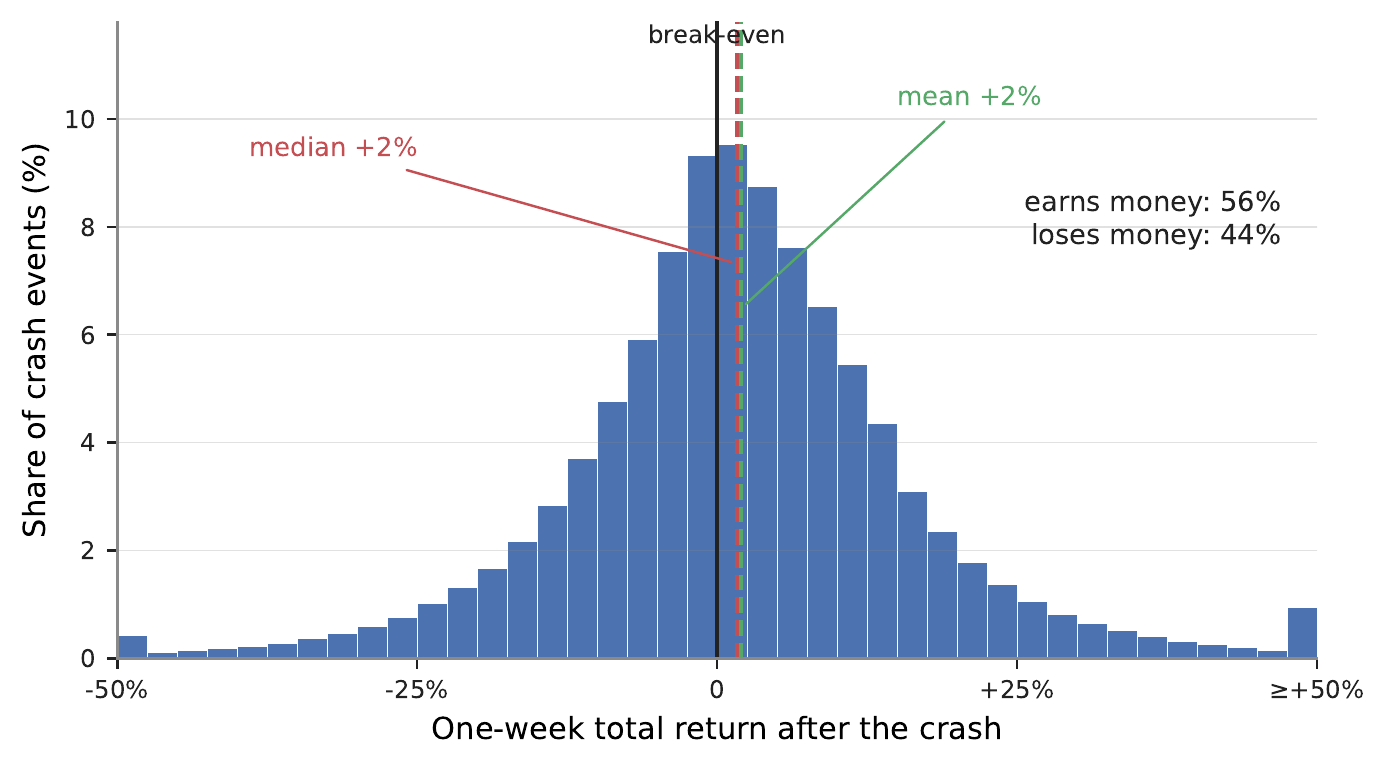
One-week returns after a crash. Stocks finished in positive territory 56.1% of the time, and the median return was about +2%.
So there really does appear to be some sort of short-term reversion after a big selloff. However, 56% is very different from the rule I had in my head. I was investing more like the probability was 90%.
A bigger crash isn’t necessarily a better opportunity
My original heuristic was particularly focused on large drops like 15-20%.
The underlying intuition was that if a stock fell that much in one day, then surely the market had overreacted. The data doesn’t really support that.
For crashes between 10% and 15%, about 57% of stocks were positive a week later. For 15–20% crashes (the range I had mentally treated as a buying signal) it was about 55%. For 20–30% crashes, it fell to roughly 54%. And for crashes worse than 30%, it was only about 51%.
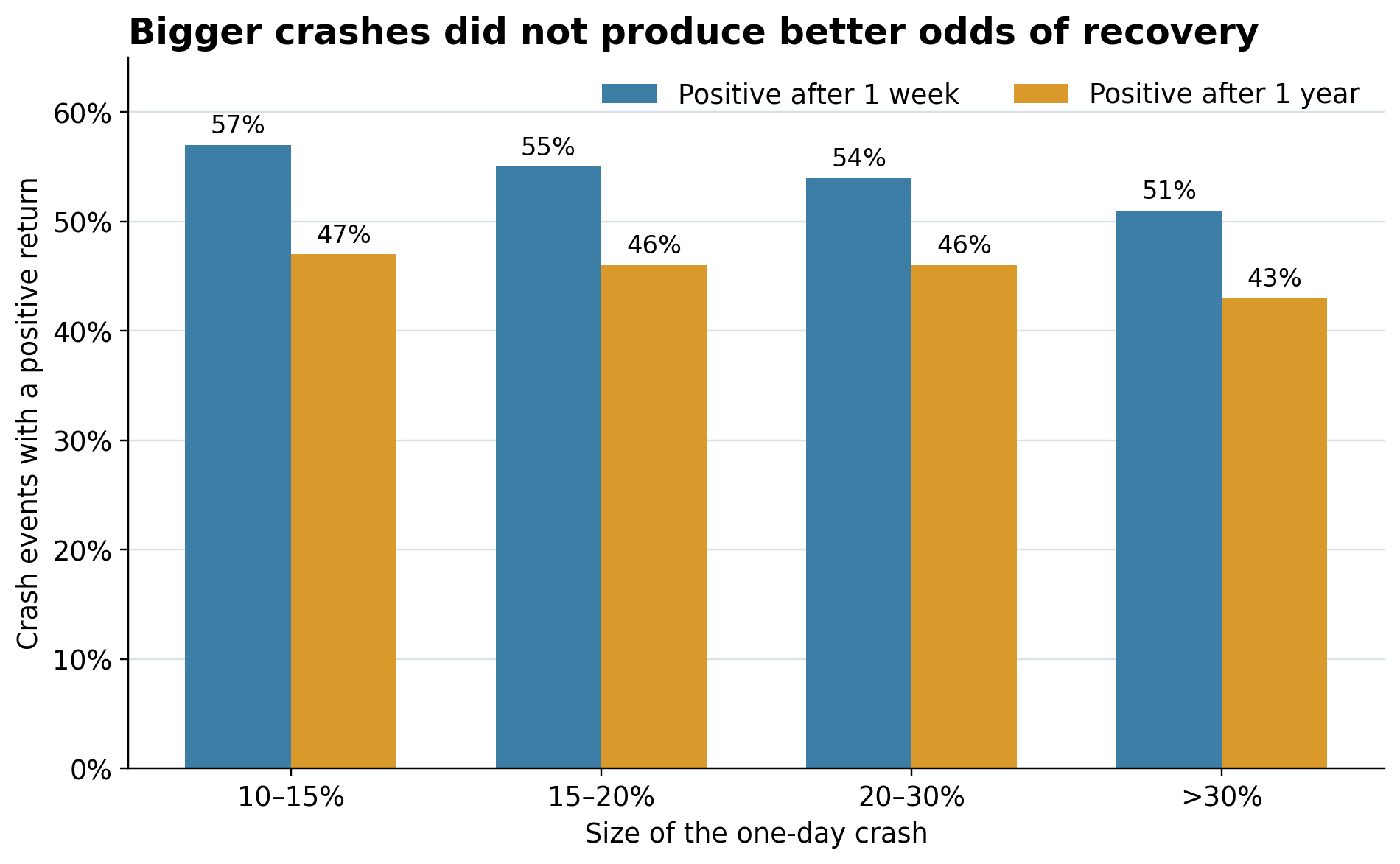
Larger crashes had worse odds of finishing positive at both horizons. The drop is gradual, but it runs in the opposite direction from my original intuition.
In other words, the size of the crash itself tells you little about whether you’re about to get an immediate recovery.
A stock being down 20% does not automatically mean it is 20% too cheap.
Sometimes the market is overreacting.
Sometimes something genuinely bad has happened.
And the harder part is figuring out which one you’re looking at.
I was also mixing up a bounce with a recovery
A stock bouncing immediately after a crash and a company actually recovering from that crash are not the same phenomenon.
Over one week, crashed stocks look pretty good: 56% are positive and the median stock gains about 2%. However, if we stretch the horizon to a year, the picture changes completely.
Only about 47% of crashed stocks are positive a year later, and the median return is about -5%. The average return is actually positive because a minority of huge winners pull it upward, but the typical crashed stock does not turn out to be a great long-term investment.
That distinction sounds obvious after the fact, but I hadn’t really thought about it when I was buying these stocks. My mental model was: Big crash → overreaction → bounce → recovery.
But those arrows are clearly not guaranteed. Some stocks bounce because they’ve become temporarily oversold, and then continue deteriorating afterward. Others barely bounce at all, but recover gradually because the underlying business remains healthy.
One of the strangest examples was sector context. Historically, a company that crashed roughly alongside its sector had some of the best one-year outcomes in the dataset: around 75% were positive, with a median return of +34%.
But those same systemic crashes were actually among the worst short-term bounces. Only about 48% were positive a week later. Meanwhile, stocks that got hit much harder than the rest of their sector tended to bounce more quickly—but had worse long-term outcomes.
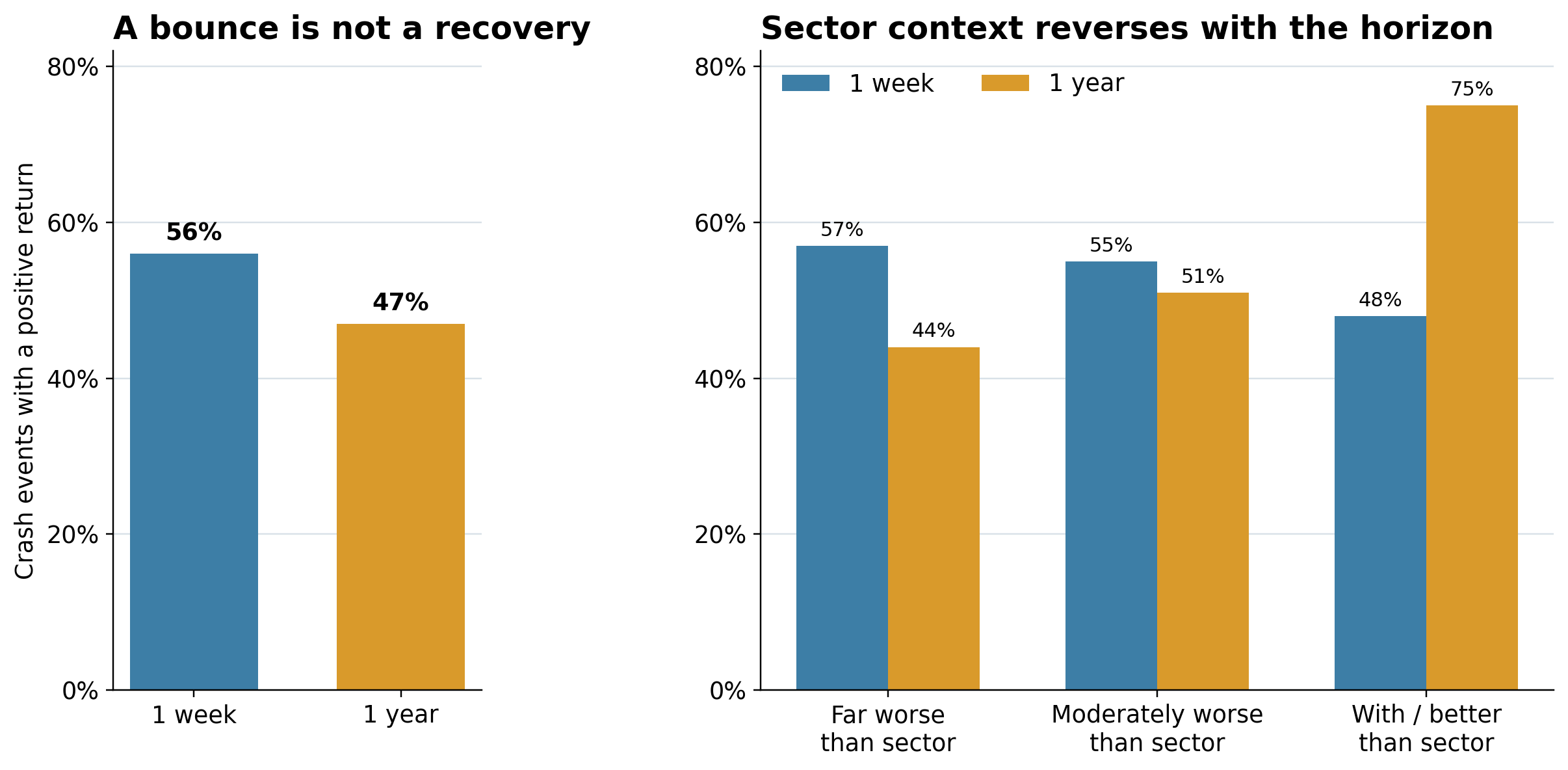
The overall short-term edge fades over a year. Sector context makes the distinction especially clear: stocks crashing with their sector bounced less often after one week, but had much stronger one-year outcomes.
That’s a pretty useful distinction: the biggest bounce isn’t necessarily the best investment.
So was my investment strategy wrong?
Not completely.
There is a measurable tendency for stocks to rebound immediately after a major selloff. My intuition that markets can overreact wasn’t invented out of thin air.
The problem was the confidence I attached to it.
I had turned:
“Stocks are somewhat more likely to bounce after a crash”
into:
“If a promising company drops 15–20%, it’ll almost certainly recover within a week.”
Those are very different statements.
The historical number is closer to 55–56%, not “almost certainly.” Also the magnitude of the crash, which was the metric I had been paying the most attention to, doesn’t appear to be particularly useful on its own.
The more interesting question is why the stock crashed and what kind of company crashed.
Is the entire market selling off? Is the company’s whole sector getting hit? Or did this particular company fall 20% while everything around it was fine? Is the business profitable? Was the stock already trading at an aggressive valuation? Had it been repeatedly crashing before today?
Those questions seem to tell you much more than simply staring at the percentage drop.
What CrowdStrike and Xanadu taught me
I still own both stocks. I’m glad I bought CrowdStrike. And despite the fact that my Xanadu position is currently down, I remain very optimistic about what the company is building. I don’t mind holding it. My belief in Xanadu’s long-term prospects and my expectation that its stock should bounce within a week are two completely separate claims. I had been subconsciously conflating them.
CrowdStrike gave me an example where my intuition appeared to work perfectly. Xanadu gave me an example where it didn’t. Looking at hundreds of thousands of crashes put both experiences into perspective.
While stocks really do bounce somewhat more often than they don’t, a crash isn’t a buy signal.
It’s the beginning of a series of questions.